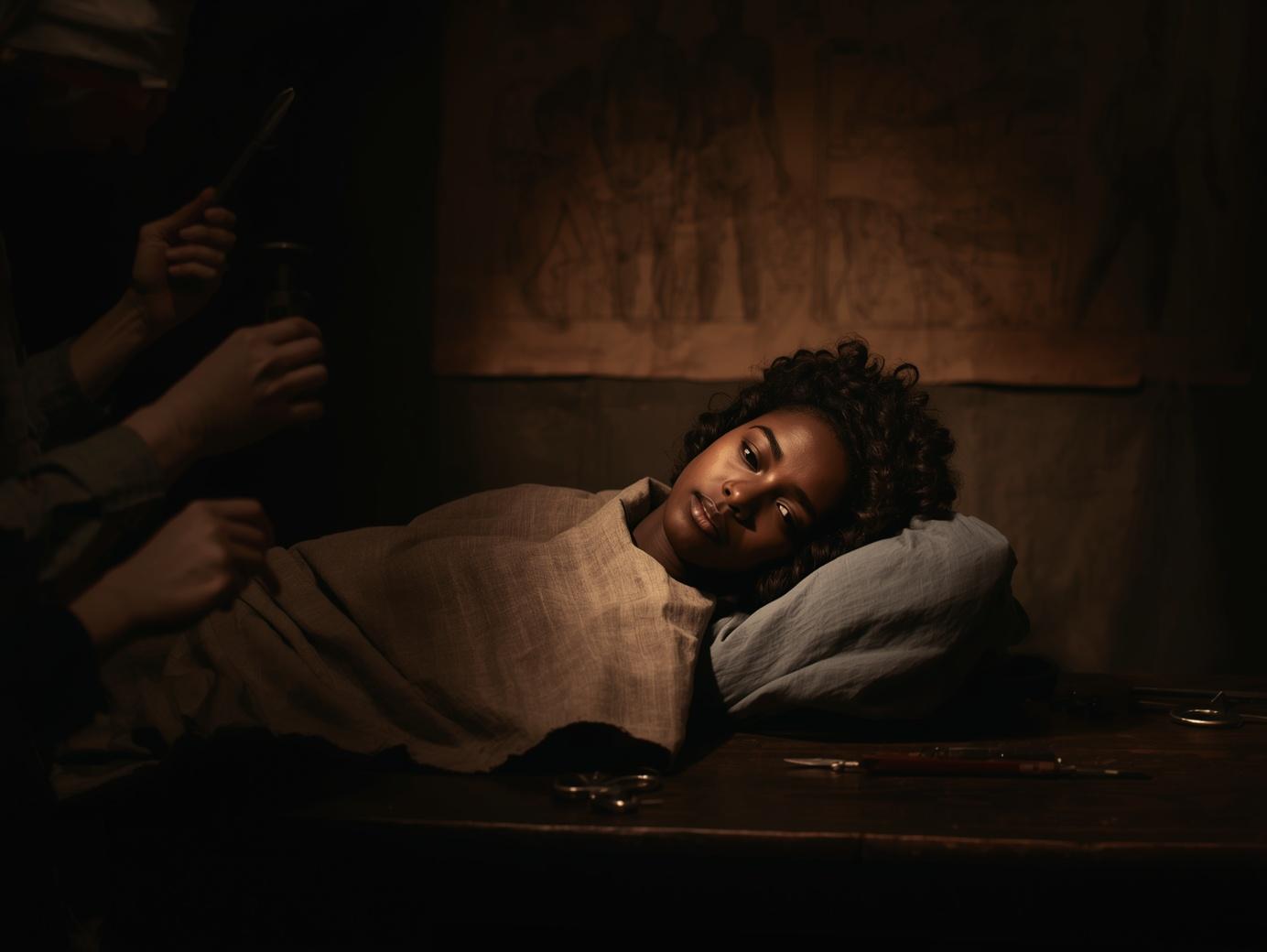
The room is quiet, but not calm.
There is no hum of machines, no soft reassurance of modern medicine. Only the presence of bodies and breath. A wooden table. Hands preparing instruments. The air is thick, not sterile.
A teenage girl is brought forward.
She does not volunteer. She does not agree. She is positioned.
There is no anesthesia.
When the procedure begins, there is nothing to dull it. No barrier between blade and nerve. No pause between pain and awareness.
She feels everything.
This is not a single moment.
It will happen again.
And again.
And again.
Her name is Anarcha Westcott.
Progress Built on a Body
There is a version of medical history that is clean.
It speaks of innovation, of breakthrough, of brilliance. It gives us names to admire and milestones to celebrate. It tells us that progress is inevitable, and that those who drive it forward deserve recognition.
And then there is the truth.
The truth is that progress is often built on bodies.
On people who did not choose to be part of history.
On pain that was not optional.
On silence that was enforced.
Anarcha Westcott was one of those people.
A teenager. Enslaved. Injured. And then subjected to repeated surgical experimentation without anesthesia, not once, not twice, but dozens of times. Her suffering did not occur at the margins of medical history. It was central to it.
This is not a story meant to comfort. It is a story that demands confrontation.
Race, Medicine, and the Construction of Pain
To understand what was done to Anarcha, we must examine not only the events, but the thinking that made those events acceptable.
Nineteenth century American medicine was not neutral. It was shaped by slavery, and it absorbed the logic of that system into its practices.
As documented in Harriet A. Washington’s Medical Apartheid, enslaved Black bodies were routinely used for experimentation. Not as a last resort, but as a starting point. Accessibility replaced consent.
Physicians developed and reinforced a set of beliefs that allowed them to proceed without moral interruption. Among the most damaging was the claim that Black people felt less pain.
This idea persists in disturbing ways. A 2016 study by Hoffman et al. found that a significant number of medical trainees still held false beliefs about biological differences in pain perception between Black and white patients.
In Anarcha’s time, this belief was not hidden.
It was operational.
It shaped decisions.
It justified withholding anesthesia.
It turned suffering into something that could be measured, observed, and repeated without accountability.
And so, what happened to Anarcha was not an anomaly.
It was a product of a system working exactly as it was designed to.
A Body in Crisis
To understand what was done to Anarcha, we must examine the intellectual and social frameworks that made it possible.
Nineteenth century American medicine did not exist outside of slavery. It was shaped by it.
Scholars such as Harriet A. Washington in Medical Apartheid document how Black bodies were routinely used in experimentation, often without consent and without anesthesia. Physicians operated within a racial hierarchy that defined who was worthy of care and who was available for use.
A central pillar of this system was the false belief that Black people experienced pain differently. This idea, traced in modern research including Hoffman et al. (2016), shows that even today some medical trainees hold misconceptions about biological differences in pain tolerance between races.
In the 1840s, this belief was not questioned. It was operational.
It justified action.
It justified neglect.
It justified what was done to Anarcha.
A Body in Crisis
At approximately seventeen years old, Anarcha endured a prolonged labor that lasted for days. Without surgical intervention, without adequate support, the pressure of childbirth caused internal tissue to die, creating a vesicovaginal fistula.
This was not a minor injury.
It meant that urine leaked continuously from her body. It meant burning skin, infection, and constant discomfort. It meant the smell of waste that could not be controlled. It meant isolation.
Accounts from similar cases in the period describe women being excluded from social spaces, forced to live apart, treated as if they themselves were the problem.
Her body had been injured.
Society responded by isolating her.
Medicine responded by experimenting on her.
Consent Did Not Exist
The procedures that followed did not take place in sterile, modern operating rooms. They occurred in a clinical environment that lacked both technological advancement and ethical constraint.
Anarcha was positioned physically in ways that exposed the injury for repeated examination and intervention. The now standard Sims position was developed during this period, not through abstract design, but through repeated use on enslaved women.
There was no anesthesia.
By 1846, ether anesthesia had been publicly demonstrated. Within years, it spread across surgical practice. Yet historical records indicate that it was not used in these procedures.
The justification was not absence.
It was decision.
The Procedures: Repetition Without Relief
Primary historical accounts, including later writings from the physician himself, describe a long process of trial and error. Techniques were not established beforehand. They were created through repetition.
Anarcha is believed to have undergone approximately thirty surgical attempts.
Thirty separate moments in which her body was opened, examined, and altered.
Each time, the procedure entered tissue already damaged by trauma.
Each time, it produced fresh injury in the pursuit of repair.
Silver sutures, later celebrated as an innovation, were tested through these repeated operations. The speculum, now a standard gynecological instrument, was refined through this process.
These tools did not emerge in isolation.
They were shaped through contact with her body.
Through failure.
Through endurance.
Through pain that was neither brief nor accidental, but structured into the process itself.
Witnessed Suffering: Lucy and Betsey
Primary accounts and historical reconstructions suggest that Anarcha underwent approximately thirty surgical attempts.
Thirty.
Each procedure involved incision into already damaged tissue. Suturing techniques were attempted, failed, and reattempted. Silver sutures, later considered an innovation, were tested through these repeated interventions.
Imagine the physical reality.
Scar tissue cut open again.
Raw tissue exposed again.
Hands, instruments, pressure, stitching.
No numbing.
No reprieve.
Pain that does not spike and end, but stretches, lingers, returns.
Recovery that is not complete before the next procedure begins.
Pain becomes not an event, but a condition of existence.
Witnessed Suffering: Lucy and Betsey
Anarcha was not alone, but that does not mean she was supported.
Lucy, another enslaved patient, underwent an early operation that left her in extreme distress. Records describe her developing severe post operative complications, including symptoms consistent with infection. She was reported to have suffered intensely for days.
Betsey, like Anarcha, endured repeated procedures as techniques were refined.
These women were present for each other’s suffering. Not as companions in healing, but as witnesses to what would likely happen to them next.
Each surgery was both an experience and a warning.
The Language of Advancement
Eventually, a successful repair technique was achieved. This moment is often recorded as a breakthrough in gynecological surgery.
And medically, it was.
The development of a reliable fistula repair transformed treatment for countless women. It reduced suffering. It restored bodily function. It advanced surgical practice.
But to speak of the outcome without the process is to participate in erasure.
Because that success was not abstract.
It was built.
Built from repetition.
Built from failure.
Built from the bodies of women who could not refuse.
Ethical Analysis: Then and Now
Modern bioethics is grounded in principles such as autonomy, beneficence, non maleficence, and justice.
What occurred here violated all of them.
Autonomy was absent. There was no consent.
Beneficence was compromised. The primary goal was experimental success, not patient wellbeing.
Non maleficence, do no harm, was repeatedly broken.
Justice was denied. The burden of experimentation fell on a population that had no power to resist it.
Some argue that ethical standards were different at the time.
This is true.
But it is also incomplete.
Because even within that historical moment, choices were made.
Anesthesia existed and was used on white patients.
Consent was valued in some contexts.
The difference was not knowledge.
It was whose suffering mattered.
Anger, Memory, and Accountability
There is a tendency, especially in institutional narratives, to neutralize stories like this. To acknowledge them in passing, to frame them as unfortunate but necessary steps toward progress.
That framing must be challenged.
Because what happened here was not simply unfortunate.
It was a system of exploitation.
And it was rewarded.
The physician at the center of this history was celebrated for decades. His name entered medical canon. Statues were erected in his honor, including one that stood in New York’s Central Park until its removal in 2018 after sustained public pressure.
For generations, students learned his name without learning hers.
This is not accidental forgetting.
It is selective memory.
And selective memory protects power.
To speak with anger about this history is not to distort it.
It is to respond to it honestly.
Reclamation: Saying What Was Taken
There is a tendency to soften stories like this. To turn them into lessons without discomfort. To acknowledge them briefly and then move on.
That impulse must be resisted.
Because what happened to Anarcha was not a neutral event in history.
It was violence.
Systemic, normalized, justified violence.
And for generations, the person responsible for that system of experimentation was honored. Statues were erected. His name was taught without critique. His work was presented as innovation, detached from the conditions that made it possible.
This is not just omission.
It is endorsement through silence.
Reclamation: Saying What Was Taken
Recent scholarship, public history projects, and activism have begun to correct this narrative.
Historians have re centered the lives of Anarcha, Lucy, and Betsey. Memorials have been created. Statues have been removed or recontextualized. Medical institutions are increasingly acknowledging this history within their training.
But recognition is not repair.
It is only a beginning.
To truly reclaim Anarcha’s place in history is to do more than name her. It is to understand what her experience represents.
It represents a system where some bodies were tools.
Where pain was data.
Where survival was not the same as justice.
Contemporary Relevance: The Echoes Remain
The legacy of this history is not confined to the nineteenth century.
Research continues to show disparities in pain management, maternal mortality, and healthcare access affecting Black women globally.
These disparities are not coincidental.
They are connected to historical patterns of neglect, dismissal, and exploitation.
When patients today report not being believed, not being treated, not being heard, they are encountering a system shaped in part by histories like this one.
Understanding Anarcha is not about the past alone.
It is about recognizing patterns that persist.
Conclusion: Refusing to Look Away
There are stories that history tells proudly.
And there are stories it buries.
This one was buried for a reason.
Because it forces us to hold two truths at once.
That modern gynecology advanced.
And that it advanced through the suffering of a girl who did not choose to be part of it.
Anarcha Westcott was not an assistant to progress.
She was its foundation.
Not metaphorically.
Literally.
Her body was where techniques were tested.
Her pain was where methods were refined.
Her endurance was where success was built.
To remember her is not to reject medicine.
It is to demand better from it.
To insist that no discovery, no matter how valuable, is worth the removal of consent, the dismissal of pain, or the erasure of humanity.
For too long, history asked us to remember one name.
Now we choose to remember differently.
We say hers fully.
Anarcha Westcott.
And we do not look away.
There are stories that are easy to tell.
This is not one of them.
Because to tell it honestly requires that we sit with discomfort. That we acknowledge that progress can be both real and deeply unjust. That we recognize that advancement and exploitation have, at times, existed side by side.
Anarcha Westcott was not a passive figure in history.
She was a young woman whose body was used in ways she did not choose, whose pain was prolonged for the sake of discovery, and whose contribution was erased for generations.
To remember her is not to reject medical progress.
It is to demand that progress be ethical.
It is to insist that no future advancement be built on the same terms.
It is to say, clearly and without softening, that what happened to her should never have been allowed.
And that remembering her is not optional.
It is necessary.
References
Washington, H. A. (2006). Medical Apartheid: The Dark History of Medical Experimentation on Black Americans from Colonial Times to the Present. Doubleday.
Hoffman, K. M., Trawalter, S., Axt, J. R., & Oliver, M. N. (2016). Racial bias in pain assessment and treatment recommendations, and false beliefs about biological differences between blacks and whites. Proceedings of the National Academy of Sciences, 113(16), 4296–4301.
Boulware, L. E., Cooper, L. A., Ratner, L. E., LaVeist, T. A., & Powe, N. R. (2003). Race and trust in the health care system. Public Health Reports, 118(4), 358–365.